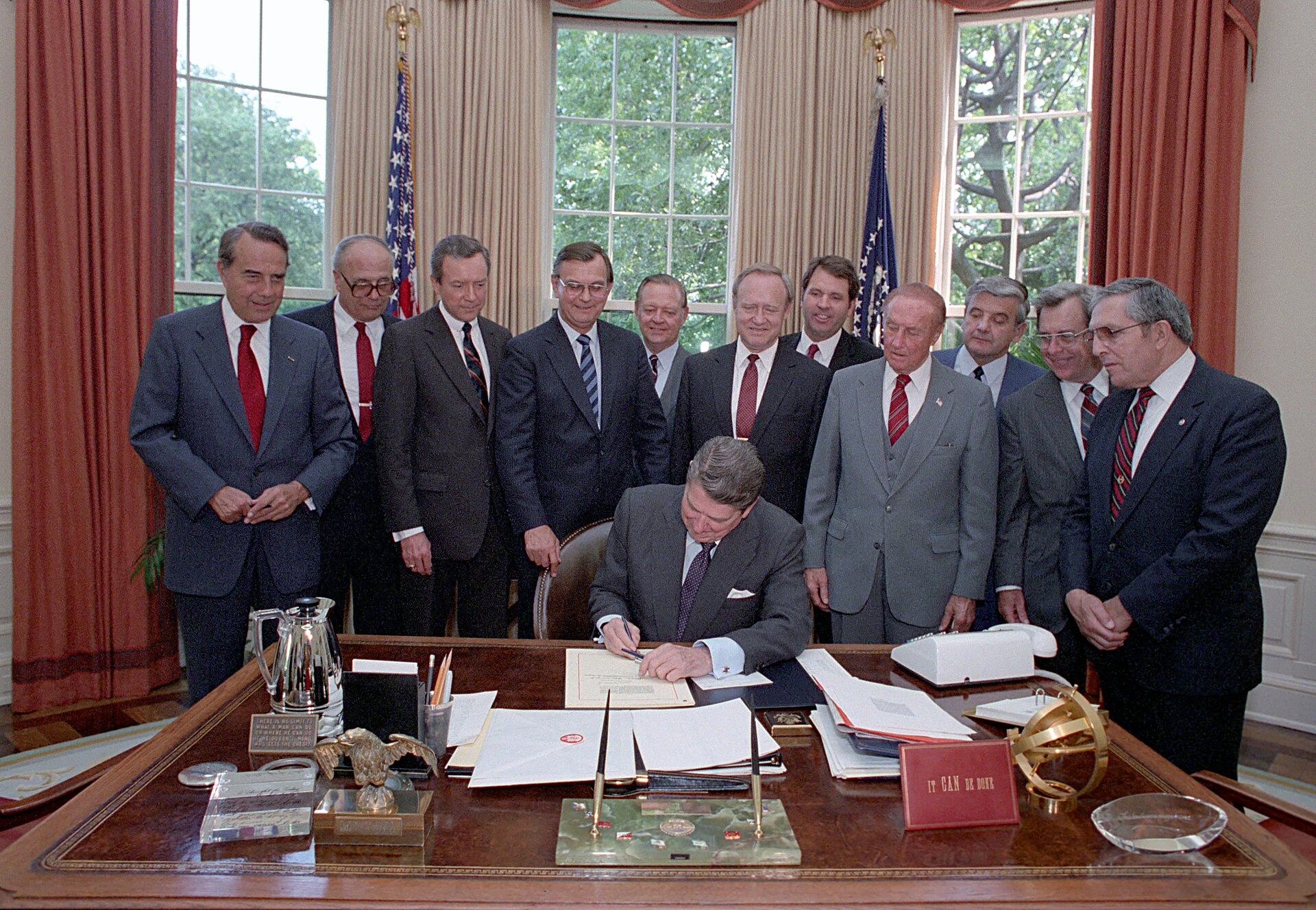

Senator James McClure of Idaho and Representative Harold Volkmer of Missouri led the effort to ease federal restrictions on gun owners and dealers. Representative William Hughes of New Jersey wanted to prohibit machine gun possession and transfers, with exceptions. In May 1986, President Ronald Reagan signed a law that did both.
Owners and dealers press Congress
The NRA and other supporters of the Firearms Owners’ Protection Act argued that the Gun Control Act left ordinary owners and dealers vulnerable to excessive enforcement. A White House briefing recorded those complaints and recommended that Reagan sign the bill.
FOPA relaxed some restrictions on interstate rifle and shotgun sales, narrowed the definition of a firearms dealer, and generally limited routine dealer inspections to once a year, with exceptions. It also protected certain interstate journeys with unloaded, inaccessible firearms. Treasury supported the package, arguing that it could protect lawful owners without weakening criminal enforcement.
Hughes’s amendment added the machine gun prohibition. The April 10, 1986 House debate ran into procedural disputes and expired time. The Congressional Record lists the amendment as agreed to without a recorded tally. The nearby 124–298 roll call concerned a motion to end the committee’s proceedings, not the machine gun amendment.
May 19 becomes a dividing line
Reagan signed FOPA on May 19, 1986, and the machine gun provision took effect that day. It exempted possession and transfers under government authority and machine guns lawfully possessed before enactment. The ordinary civilian market was left with an existing pool of transferable firearms.
A manufacturer could keep making a model for qualifying government customers. New examples generally could not enter the civilian stock, so private buyers had to look to the existing supply. A gun’s legal history now mattered alongside its condition.
The restriction became §922(o) of the Gun Control Act. NFA registration and taxes still applied to permitted transfers. Paying the NFA tax could not authorize a transfer that §922(o) prohibited. FOPA also broadened the statutory treatment of machine gun conversion parts and silencer parts.
Sources for this passage 01
A $200 refund reaches the Supreme Court
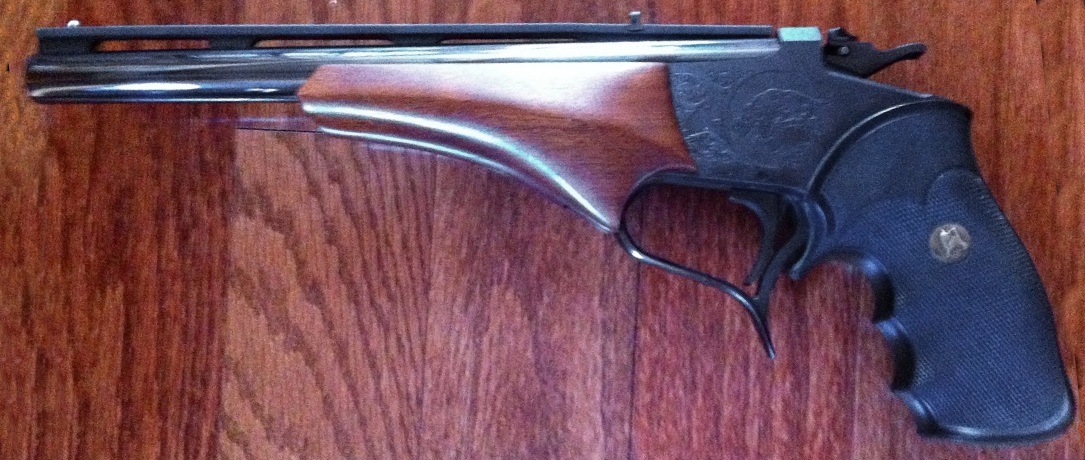
Thompson/Center Arms sold the Contender pistol and a kit that allowed it to be used as a rifle. ATF treated selling the package together as making an NFA firearm, although the parts also had a lawful configuration outside the short-barreled-rifle category. The company paid the $200 making tax, sought a refund, and went to court when it did not get one.
In United States v. Thompson/Center Arms Co. in 1992, the Supreme Court upheld the judgment for the manufacturer. Justice David Souter’s plurality found the statute ambiguous as applied to the package. Because the NFA carried criminal penalties as well as taxes, the plurality resolved the uncertainty in the company’s favor under the rule of lenity. Justices Antonin Scalia and Clarence Thomas agreed with the result for different reasons.
A tax-refund suit had allowed the manufacturer to contest ATF’s classification. The judgment covered this kit; the short-barreled-rifle category remained in the law.
Sources for this passage 01

What did Harold Staples know?
Officers seized a rifle from Harold Staples’s home that fired automatically when government agents tested it. Staples testified that it had never fired that way while he owned it. He asked for a jury instruction requiring proof that he knew of its automatic capability. The judge refused, and the jury convicted him.
The Supreme Court reversed in 1994. In Staples v. United States, Justice Clarence Thomas emphasized the longstanding lawful ownership of guns and the severity of the possible punishment. Possession alone was not enough without proof that the owner knew the relevant facts.
Prosecutors had to prove that Staples knew his rifle had the characteristics that made it a machine gun. They did not have to prove that he knew the NFA or understood its registration requirement.
Sources for this passage 01
The laws alongside the NFA
Congress was also changing rules for a much wider range of firearms. The Brady Act of 1993 led to the National Instant Criminal Background Check System, or NICS, which began operating on November 30, 1998. Licensed sellers could check buyers against records of disqualifying convictions and other legal prohibitions. A buyer’s eligibility was a separate question from the firearm’s classification.
The 1994 federal assault-weapons law restricted specified semiautomatic firearms and large-capacity magazines, with exceptions for previously lawful items and other uses. Its model lists and features did not turn every covered semiautomatic firearm into an NFA machine gun. Congress gave the law ten years. It expired on September 13, 2004; the NFA and the 1986 machine gun cutoff stayed in force.
Sources for this passage 02
ATF leaves Treasury
The Homeland Security Act moved ATF’s law-enforcement functions to the Department of Justice on January 24, 2003. It became the Bureau of Alcohol, Tobacco, Firearms and Explosives. Alcohol and tobacco tax collection went to a separate Treasury bureau. Administration of the NFA went with ATF to Justice.
A criminal law-enforcement agency still administered a firearms law in the federal tax code. That arrangement would matter again when Congress cut most NFA taxes to zero.